The 28-Day Rule and the 5-Unit Exemption Are Not the Same Thing

August 4, 2026

Share this article

Search "how many days can I camp without planning permission" and you'll find answers mentioning 28 days, others mentioning five units with no day limit at all, and very few explaining that these are actually two completely separate legal mechanisms. If you've come away from your research more confused than when you started, that's why.

Mechanism one: the 28-day permitted development right

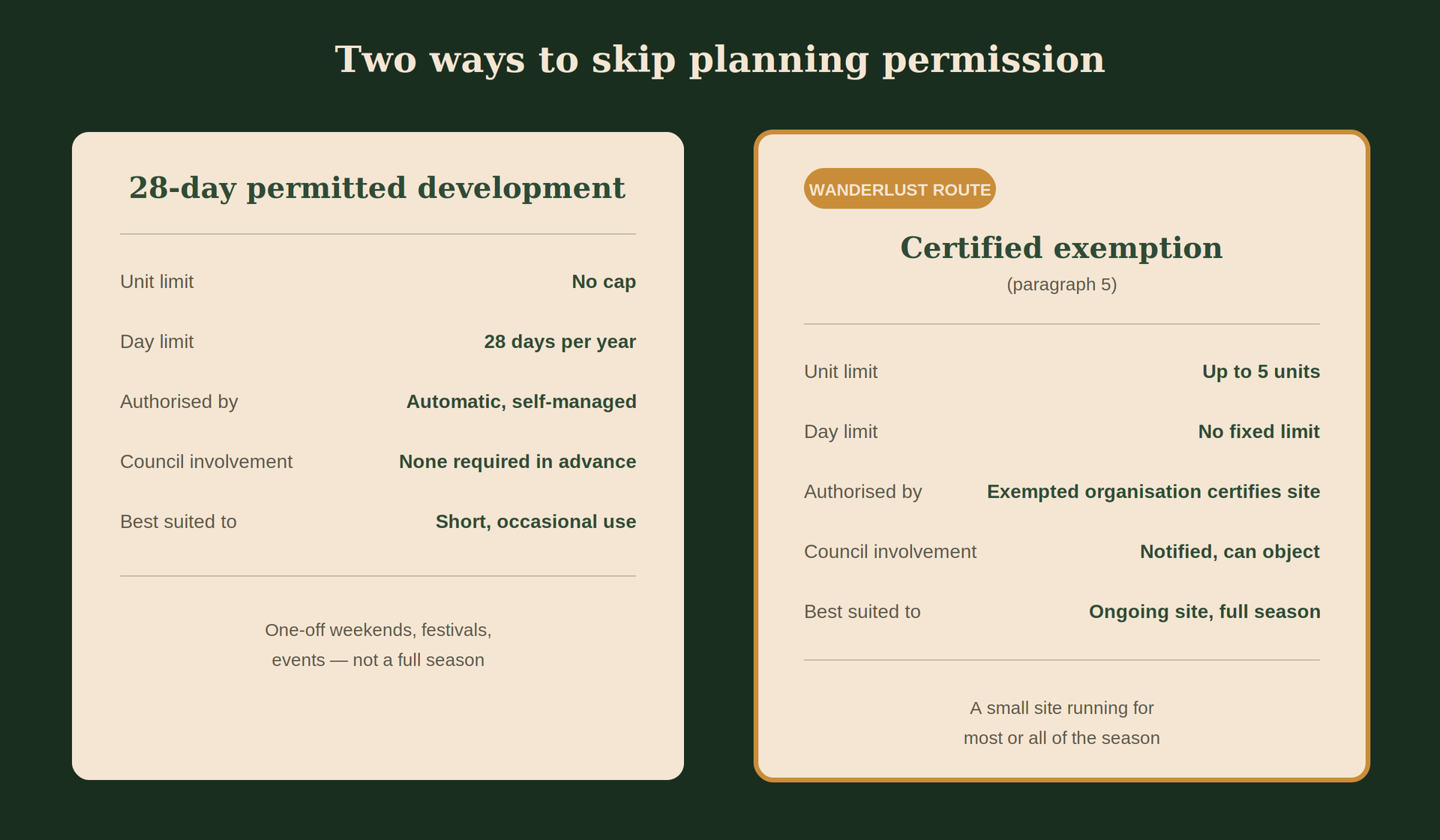
Under permitted development rules (set out in the Town and Country Planning General Permitted Development Order), a landowner can use land for camping — tents, caravans, motorhomes — for up to 28 days in any calendar year, without needing planning permission or going through an exempted organisation at all.


The trade-off is the time limit. Once you've used your 28 days, that's it for the year, regardless of how many units were on site or how it was run. This suits a one-off event, a festival weekend, or occasional short bursts of use — not a site you want running for most of the season.


Mechanism two: the certified exemption (paragraph 5)

The certified exemption works completely differently. Under the Caravan Sites and Control of Development Act 1960, an exempted organisation — such as Wanderlust Camping Club — can certify a site for up to five units, with no fixed day limit on how many days a year it operates, provided the site is properly certified and the local authority hasn't raised a valid objection.

The trade-off here is the unit cap rather than a time limit: five units, but potentially year-round, rather than unlimited units for a short burst.


Side by side


Why this distinction actually matters

Getting the two confused tends to go wrong in one of two directions. Some landowners assume the 28-day right means they can run a small site all season as long as they keep unit numbers low — it doesn't; the day count is what matters, not the size. Others assume the certified exemption comes with a day limit like the 28-day rule does, and needlessly restrict their own season when they don't have to.


Knowing which mechanism actually fits your plans — a handful of one-off weekends, or a proper season-long small site — decides which route makes sense, and neither one is "better" in the abstract. They're built for different situations.


Which one is right for you?

If you're picturing occasional use — a summer festival tie-in, a wedding weekend, a handful of one-off events — the 28-day right is probably the simpler route, and doesn't require certification by anyone.


If you're picturing a small site that's actually open for most of the season, capped at a manageable size, the certified exemption is very likely the better fit — and it's the route that gives guests (and you) the reassurance of proper vetting behind it.


Not sure which route fits what you're picturing? Get in touch and we'll help you work out which one actually applies.


Recent Posts

August 4, 2026
Certification isn't a quick form and a rubber stamp — it's a proper vetting process, and we're upfront about that from the first conversation. So rather than tell you it's worth it, we thought it was more useful to let the site owners who've been through it say so themselves.
August 4, 2026
"Vetted, not viral" is easy to put on a website. It's a lot more meaningful once you know who's actually doing the vetting.
August 4, 2026
Type "planning permission for glamping" into Google and you'll fall down a rabbit hole of council jargon, forum horror stories, and blog posts that all seem to disagree with each other.
August 4, 2026
Farm incomes have been squeezed for years, and diversification has gone from a buzzword to a necessity for a lot of landowners. Holiday lets, wedding barns, farm shops — all well-trodden paths, and all requiring significant capital and, usually, full planning permission.
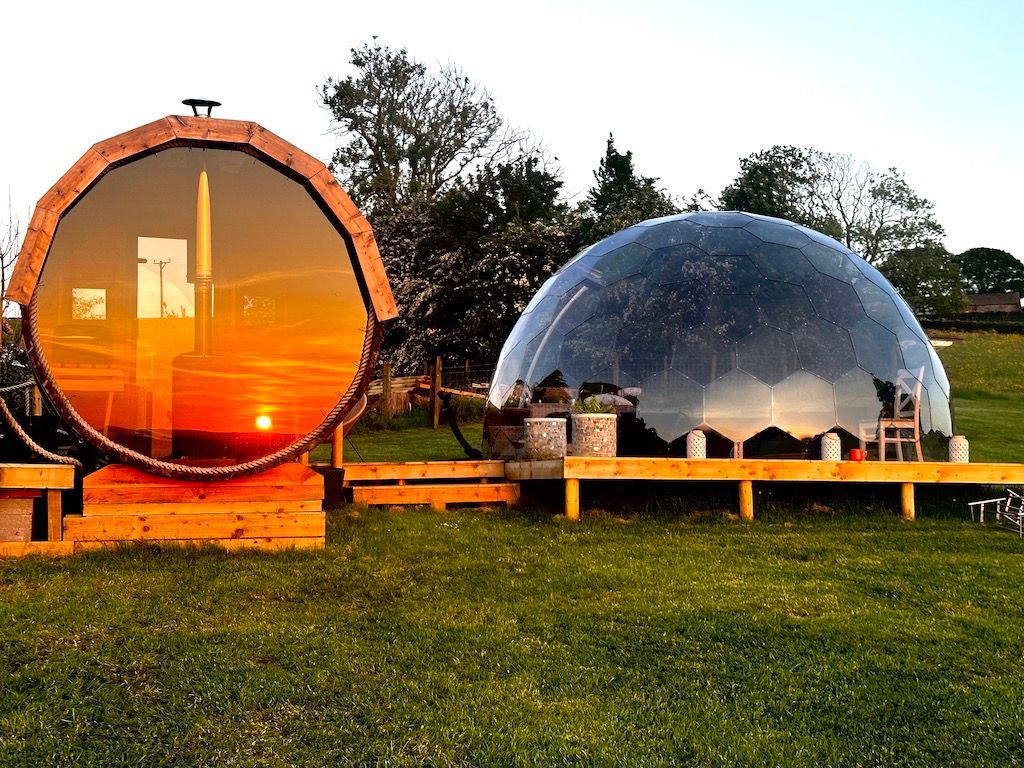
Two dome-shaped structures on grass, one orange and one clear, at sunset.
June 25, 2026
Looking for unique glamping and camping sites in the UK? From mirrored glass retreats to converted horseboxes and riverside vehicle conversions, our network of independently run sites proves that no two stays are ever the same. Browse unique stays across the Lake District, Yorkshire Dales, Shropshire, Cheshire, and Wales - and find the one that's missing from your bucket list.

Person in a black beanie and denim jacket sitting by the shore at sunset, looking at a phone
June 10, 2026
Not the version where you put your phone face-down at dinner and call it a digital detox.
Green rolling hills above a village with red-roofed houses under a partly cloudy sky
June 10, 2026
Britain is wilder than you think. The evidence is out there, down a quiet lane, at the end of a field track.
Campsite with a beige tent in a wooded clearing, surrounded by tall trees and hanging white hammocks.
June 10, 2026
There's a particular kind of traveller who's started to ask a different question. Not just where do I want to go — but how do I want to do it?

Small evergreen sapling growing in dry soil, with a blurred forest background.
June 10, 2026
When you book a stay at any Wanderlust site, a share of your membership contribution is channelled into wildlife support
White hard hat beside architectural plans and a clipboard on a sunlit desk.
June 10, 2026
Exemption Certification solves the legal question of permission to operate. But Wanderlust membership goes further than that - we're by your side, filling your units with bookings.

Show More